Tu-Darmstadt Programming Contest 2001, no.3 Knight Moves October 07, 2013
문제요약
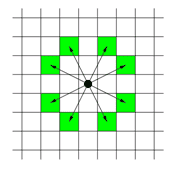
나이트가 한 번에 이동할 수 있는 위치가 아래와 같이 있고, 현재 위치와 목적지 위치가 주어졌을 때 현재 위치에서 목적지까지의 최단거리를 구하는 문제이다. 체스판은 정사각형이며 한 변의 길이 $L$이 주어진다$(1\leq{}L\leq{}300)$.
해법
한 변의 길이도 $300$밖에 안되고 그래서 여러 솔루션이 존재할 것 같다. 나는 그냥 $BFS$를 돌면서 범위를 점차 넓혀가며 목적지까지 도착을 하였고, 결국 최단경로를 찾는 문제이므로 $Dijkstra$를 돌려도 되지 않을까 싶다. 하지만 그냥 쉽게 $BFS$돌리는게 더 나을 것 같다.
#include <cstdio>
#include <cstring>
#include <algorithm>
#include <vector>
#include <map>
#include <queue>
using namespace std;
typedef pair<int,int> ii;
int dy[]={-2,-1,1,2,2,1,-1,-2};
int dx[]={1,2,2,1,-1,-2,-2,-1};
int n;
int main() {
    int tc;
    scanf("%d",&tc);
    while ( tc-- ) {
        scanf("%d",&n);
        ii in,goal;
        scanf("%d%d%d%d",&in.first,&in.second,&goal.first,&goal.second);
        queue<ii> q;
        q.push(ii(in));
        bool vis[333][333]={};
        int d[333][333]={};
        while ( !q.empty() ) {
            ii now = q.front();q.pop();
            if ( now.first == goal.first && now.second == goal.second ) break;
            for ( int i = 0 ; i < 8 ; i++ ) {
                int ny=now.first+dy[i],nx=now.second+dx[i];
                if ( ny < 0 || nx < 0 || ny >= n || nx >= n || vis[ny][nx] ) continue;
                d[ny][nx] = d[now.first][now.second]+1;
                vis[ny][nx] = true;
                q.push(ii(ny,nx));
            }
        }
        printf("%d\n",d[goal.first][goal.second]);
    }
    return 0;
}
